
Burns, Disfigurement, and Psychological Trauma
Permanent scarring, disfigurement, and emotional harm
Some injuries fade. A sore neck loosens up over a few weeks, the bruising clears, and the person goes back to the life they had before the crash. Burns, disfigurement, and the psychological trauma that rides alongside them are not like that. They are among the most life-altering things a collision can do to a person, and because the harm is permanent, the non-economic side of those damages runs much higher than it does for an injury that heals on its own.
And so the question a jury faces in these cases is fundamentally different from the question in a routine claim.
The reason is simple, and in the state of Texas it tracks how juries actually think. When a loss never goes away, a jury is being asked to compensate someone not for a few months of discomfort but for the rest of a life that has been permanently changed. That is a different question, and it carries a different number. This chapter walks through why second- and third-degree burns leave damage medicine cannot fully repair, why losing an arm or a leg costs far more than the prosthetics and home modifications it requires, and why the largest loss in these cases is almost never the one on the medical bill.
The throughline is the one this whole book is built on: the type of injury drives what a car accident compensation claim is worth. With burns and disfigurement, the injury is permanent, the impact reaches into every part of daily life, and juries understand that.
when you think about what is the most valuable to people in life, it's your quality of life, your ability to do the things that you normally enjoy doing. And so when you have a disfigurement injury and it's impacted your enjoyment of your life, juries understand, that's a big loss.
Why burns don't fully heal
There are different severities of burn injury, but the serious ones share a hard truth: they don't fully heal. Second- and third-degree burns leave scarring for the rest of a person's life, along with residual pain that doesn't resolve the way a strained muscle does. And there is very little that plastic surgery can do to fix injuries at that level. Medical science hasn't reached a point where it can make these go away.
That permanence is exactly why the non-economic side of these damages is so much more extensive. When an injury will never go away, the person has to deal with it the rest of their life, and the value of the claim has to account for a lifetime, not a recovery period. A burn is not a bill that stops once the hospital stay ends. It is scarring you wake up to every morning and pain you carry indefinitely. And so juries understand the severity of that, and they compensate accordingly.
This is where the spine of every car accident claim shows up again. The crash type tells you how the collision happened and who is at fault. The injury type tells you what the harm is actually worth. A permanent, disfiguring burn sits at the far end of that second axis, and the compensation reflects it.
Disfigurement: the medical cost is only the beginning
Disfigurement works the same way, and it makes the point even more clearly. Lose an arm or a leg, and you will have real medical damages attached to it. You'll need prosthetics. You'll have to modify things around you in order to get around. You may need mobility-assisted devices, and all of that costs money, much of it for the rest of your life.
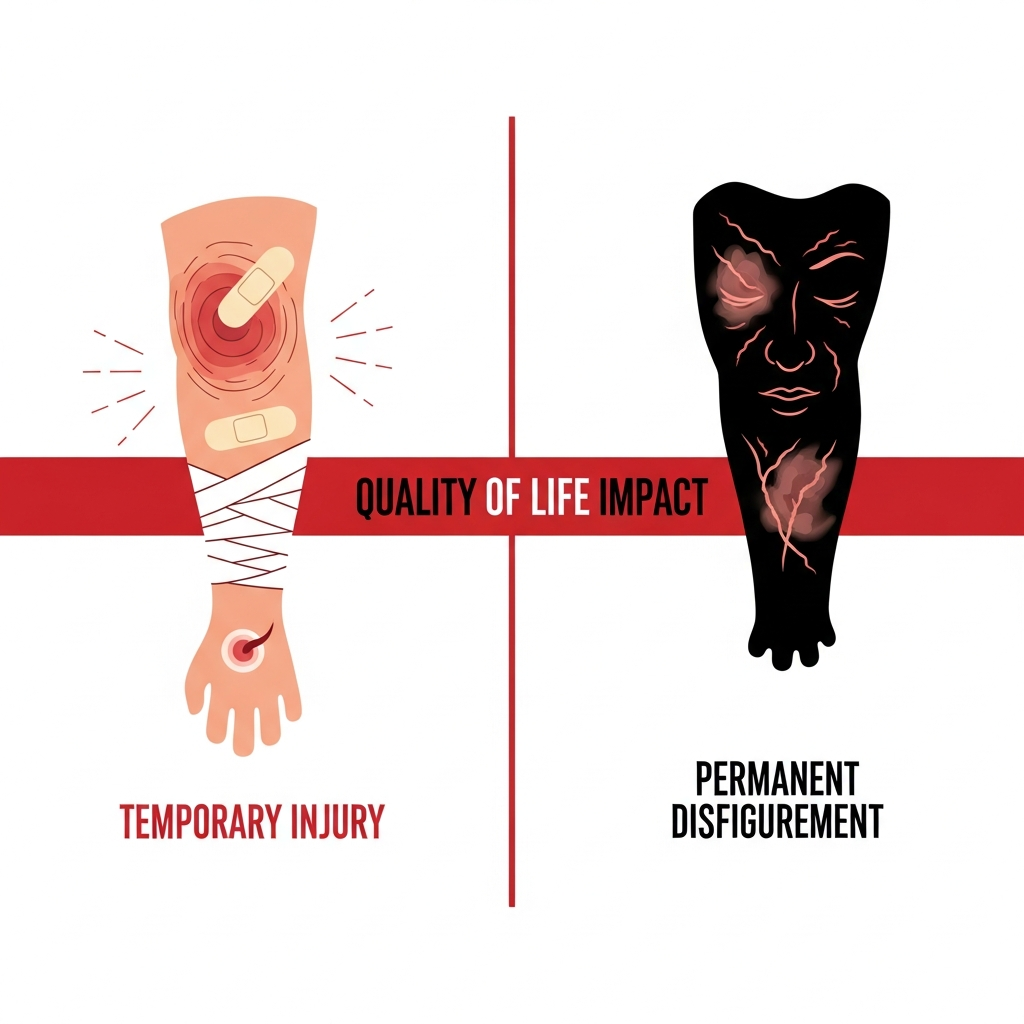
But the medical cost is only the beginning. The larger loss is the loss of quality of life. It's the ability to do the things you used to enjoy doing, the things that, when you actually stop and think about it, are the most valuable things a person has. When a disfigurement injury reaches into someone's enjoyment of their own life, that is a really big loss, and a jury sees it as one. They will compensate for pain and suffering a great deal more in those circumstances than they would for a minor whiplash where the pain goes away after a month or two and the person is back to normal.
That contrast is the whole point. Hold a permanent disfigurement up next to a soft-tissue injury that resolves on its own, and the difference in value is enormous. Not because one person hurts and the other doesn't, but because one harm is over in a few weeks and the other lasts a lifetime. You can read more about how the firm approaches these claims on our Houston car accident lawyer page.
What juries actually understand
The thing that holds all of this together is that juries genuinely understand the severity of these injuries. That isn't a marketing line. It is what shows up when ordinary people from the community sit in the box and hear what a burn or an amputation has taken from someone. They understand that scarring for the rest of your life is a permanent loss. They understand that not being able to do the things you used to enjoy is a real harm, not an abstract one.
A lawyer's job in these cases is to make that loss legible. You have to show the jury what the injury has done to the person's life and what it's taken away, then make sure that the value on those things is one the jury can fairly compensate for. When the harm is visible and permanent, that job gets easier, because the jury isn't being asked to imagine a loss. They can see it. The challenge in lighter cases is convincing a jury that real harm is there. In burn and disfigurement cases, the harm announces itself, and the work is helping the jury understand its full reach across a lifetime.
That is why permanent injuries sit at the top of the value scale. Not because of any single dollar figure, but because everyone in the room understands that quality of life is the thing people value most, and these injuries take it away for good.
Psychological trauma as part of the harm
The trauma that follows a serious crash belongs in this same conversation. Texas law recognizes mental anguish, past and future, as part of the damages a person can recover, right alongside pain and suffering and disfigurement. The psychological weight of carrying a permanent injury, living with scarring that won't fade, and adjusting to a body that no longer does what it used to is part of what the injury has actually cost a person.
Like the physical harm, the psychological side is most significant when it is lasting. A jury asked to compensate for mental anguish is being asked the same underlying question as with a burn or an amputation: how has this changed the person's life, and how long will they carry it? When the answer is "permanently," the compensation has to reflect a permanent loss. Pairing the visible injury with the lived reality of carrying it is how the full harm gets told.
Common Questions
- Why do burn injuries lead to higher compensation than other injuries?
- Burns lead to higher compensation because they don't fully heal. Second- and third-degree burns leave scarring for the rest of your life and residual pain, and there's very little plastic surgery can do to fix them. Because the injury is permanent, the non-economic damages are far more extensive than for an injury that resolves on its own. As Hank puts it, "it will never go away," and juries understand the severity of that.
- Does losing an arm or leg only cost the price of prosthetics?
- No. Prosthetics, mobility-assisted devices, and home modifications are real medical costs, but they're only the beginning. The larger loss is quality of life, the ability to do the things you used to enjoy doing. Hank's point is that quality of life is "the most valuable to people," so juries compensate a great deal more for a permanent disfigurement than for an injury that fades.
- How does a permanent injury compare to whiplash in terms of compensation?
- A permanent injury is worth substantially more. A minor whiplash where "the pain goes away after a month or two" and you're back to normal carries far lower non-economic value than a burn or disfigurement that lasts a lifetime. The difference isn't whether someone hurts; it's whether the harm ends in weeks or stays for good. Juries weigh that permanence directly.
- Can you recover for psychological trauma after a crash in Texas?
- Yes. Texas allows recovery for mental anguish in the past and future as part of your non-economic damages, alongside pain and suffering and disfigurement. The psychological weight of living with a permanent injury is part of what the crash has cost you. As with the physical harm, the value is highest when the trauma is lasting, because the jury is compensating for a permanent change to your life.
Chapter Reflection
Burns and disfigurement sit at the far end of the injury spectrum for one reason: they don't go away. Medical science can do a great deal, but it can't undo a third-degree burn or restore a lost limb, and so the person lives with the loss permanently. And that permanence is what drives the value, because juries understand that the most valuable thing a person has is the ability to live the life they used to live, and these injuries take that away. The harm in these cases is rarely hidden, which makes the lawyer's job one of fully showing its reach rather than proving it exists. But proving the injury and proving its lifelong cost are not the same thing, and that distinction depends on evidence a jury can trust. The next chapter turns to exactly that: the medical records, expert testimony, and treatment timelines that turn an injury into a number a jury can stand behind.