
Broken Bones, Internal Injuries, and Future Medical Costs
Orthopedic and internal trauma plus future medical cost
When someone breaks bones or suffers internal injuries in a car accident, the bills start stacking up almost immediately, and they don't stop when the cast comes off. There's the emergency room, the surgery, the follow-up imaging, the physical therapy. For a lot of people, that's the part they can see and feel, so that's the part they think their case is about. It's only one part. In the state of Texas, if you were involved in an accident, you have a right to make a claim for a full menu of damages, and the medical bills you've already paid are just the first line item on it.
This chapter walks through that full menu, because what your case is worth depends on whether someone bothers to account for all of it. The damages typically include past medical bills and future medical bills, past lost wages and future loss of earning capacity, and then the non-economic damages: pain and suffering, mental anguish, and disfigurement, each of those in the past and in the future. That's a lot of categories, and each one is real money you're entitled to. But there's a catch built into how the law works, and most people never hear about it until it's too late to do anything: you get one shot at recovery. You don't get to come back in five years and ask for more when the next surgery comes due. So the whole game is making sure the picture in front of the jury includes not just what you've already been through, but everything you're going to need going forward.
And so that's the move a good lawyer makes, and it's really the difference between a settlement that covers your past bills and one that actually protects the rest of your life.
As a lawyer, what you want to do and what you want your lawyer to do if you were involved in an accident is to make sure that they fully understand the picture that you're gonna have to deal with. Not only what I've had to do in the past, but then what am I going to need in the future?
Start with what the law actually puts on the table, because most people undersell their own claim simply by not knowing what's available. In Texas, a car accident claim for damages typically includes past medical bills, future medical bills, past lost wages, and future loss of earning capacity. Those are the economic damages, the ones tied to a dollar figure on a bill or a paycheck.
Then there's the other side of the ledger, the non-economic damages. Those cover pain and suffering, mental anguish, and disfigurement, and each one applies both to what you've already lived through and to what you'll carry forward. Past and future. The reason that distinction matters is that an injury doesn't sit still in time. The pain you felt in the months after a crash is one harm. The pain you'll feel for the next thirty years is a separate harm, and the law treats it that way.
What ties all of these together is a single principle that runs underneath the whole claim: you have to prove every category to recover for it. The right to compensation exists, but the law doesn't hand it to you. You build it. If you want to learn how Texas law treats a serious Houston car accident claim, the categories above are the framework every case is built on.
Why Future Medical Is the Whole Ballgame
Here's where a case is usually won or lost, and it's the part that's easiest to get wrong. As a lawyer, what you want, and what you want your lawyer to do, is to make sure they fully understand the picture you're going to have to deal with. Not only what you've had to do in the past, but what you're going to need in the future.
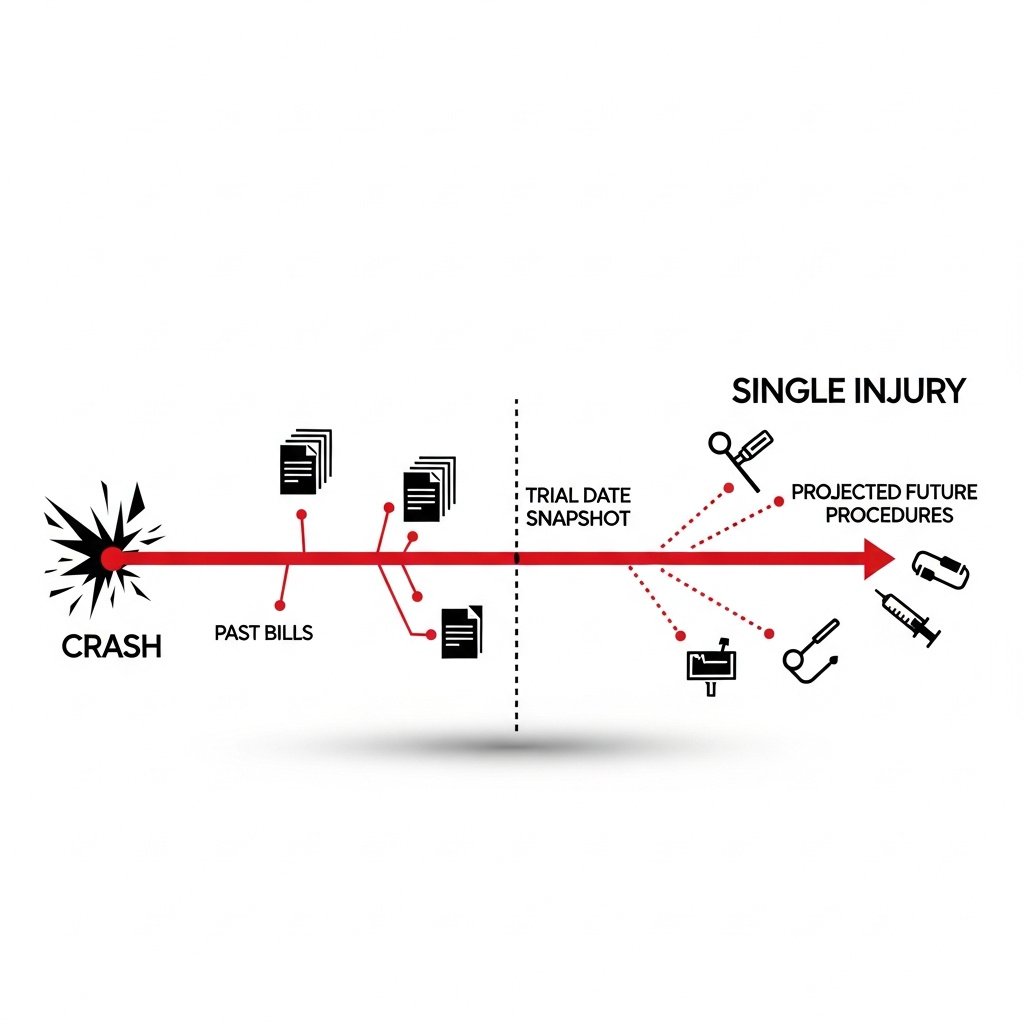
Think about what that actually looks like for someone with a serious injury. Did you have a back surgery? Then the real question is whether you'll need another one as a result of the first. Did you have to have ablations, the procedure that burns the nerves causing your pain? Those aren't a one-time fix. The nerves grow back, and you will likely need them again. They wear off, and you need them again. If your lawyer only puts your past bills in front of the jury, every one of those future procedures comes out of your own pocket, because the case is over and you don't get a second claim.
That's the trap. You get one shot at recovery. A jury sees a snapshot of where you are on the day of trial, and unless someone shows them where this injury is headed, they compensate the snapshot. And so the work is making the future as concrete and as provable as the past, so that at the end of the day the jury sees the whole arc of what this crash is going to cost you.
Life Care Planners and How You Prove the Future
So how do you put a number on treatment that hasn't happened yet? You don't guess, and you don't ask the jury to guess. You bring in an expert, often an expert called a life care planner.
A life care planner is typically a doctor or a specially trained nurse who reviews your medical records and projects forward. They look at what's been done and say, here is the type of treatment this person is going to need in the future, for the rest of their life, and here is the cost associated with it. That projection is what turns "future medical" from a vague worry into a line item a jury can actually award. Without it, future medical is just a lawyer asserting something. With it, it's a qualified professional walking the jury through the years ahead procedure by procedure.
The reason this is worth doing is that under Texas law, you're entitled to receive compensation for all of your future medical damages. The entitlement is already yours. But the way the process works, you have to figure out what those damages are, and then make sure that you present them to the jury in a way they can understand, so they can fairly compensate you for your losses. The life care planner is how you do both. A firm that prepares its car accident cases as if every one is going to trial builds that future-medical proof in from the start, rather than scrambling for it at the end.
Common Questions
- What damages can I recover for a broken bone or internal injury in a Texas car accident?
- In Texas, your claim typically includes past medical bills, future medical bills, past lost wages, and future loss of earning capacity, plus non-economic damages for pain and suffering, mental anguish, and disfigurement, each in the past and in the future. As Hank puts it, you have a right to make a claim for damages the moment you're injured in an accident. The categories are broad, but you have to prove each one to recover for it.
- What is a life care planner and why would my case need one?
- A life care planner is typically a doctor or specially trained nurse that can look at your medical records and say, this is the type of treatment the person's going to need in the future for the rest of their life, and here's the cost. They translate a vague sense that you'll need more care into a specific, provable dollar figure. For serious injuries with ongoing treatment, they're often the only way to put future medical costs in front of a jury in a form the jury can actually award.
- Why does it matter so much to prove future medical costs now instead of later?
- Because you get one shot at recovery. A jury sees only a snapshot of where you are at trial, and once the case resolves, you can't come back later for the next surgery or the next round of treatment. If your future needs aren't proven and presented now, you pay for them yourself. Under Texas law you're entitled to compensation for all future medical damages, but the burden is on you to figure out what they are and prove them.
- Are pain and suffering damages separate from my medical bills?
- Yes. Medical bills are economic damages, tied directly to the cost of treatment. Pain and suffering, mental anguish, and disfigurement are non-economic damages, and they're recoverable on their own, both for what you've already endured and for what you'll live with going forward. A serious injury can generate significant non-economic damages that have nothing to do with the size of the bill.
Chapter Reflection
The throughline of this chapter is that a broken bone or an internal injury is never just about the bills already sitting on your kitchen table. The law gives you a wide menu, past and future, economic and non-economic, and the whole value of your case turns on whether someone accounts for all of it before you settle. Future medical is the part nobody can afford to miss, because the law only gives you one recovery. Get the right experts, build the full picture, and the jury can fairly compensate you for the life this injury actually changed, not just the part of it that's already happened. That same principle, proving what a jury can't see on its own, is exactly what makes medical evidence and expert testimony the connective tissue of every serious claim, which is where we go next.