
Pileups, Rollovers, and Hit-and-Runs: The Hardest Cases
Multi-vehicle wrecks, rollovers, and untraceable drivers
Most car accident cases come down to one question that has a clear answer: who hit whom. A rear-end collision on a Houston highway usually tells its own story. A T-bone at an intersection turns on who had the right of way. But some crashes don't hand you the answer. Multi-car pileups on the freeway, rollovers, single-vehicle crashes, hit-and-runs, and road-hazard cases all sit in a different category. They are more complicated, and they are harder to work up.
Here is the part that trips people up. Your damages do not change because the crash was complicated. If you were hurt, you are still entitled to your medical bills, your lost wages, and your pain and suffering, the same as you would be in any other collision. What changes is the work it takes to figure out who is responsible. And that is the whole challenge of these cases. The recovery is the same. The road to get there is a lot harder.
This chapter walks through how we prove the cases other firms shy away from. It covers chasing surveillance before it gets written over, canvassing the area for the truck that caused the collision, and identifying a vehicle from what fell off it. It covers the brutal time pressure that runs through all of it, because in these cases evidence disappears fast. And it covers two pieces of Texas law that decide who pays when more than one driver is at fault: proportionate responsibility and joint and several liability.
We have a case where a piece of metal fell off the back of a trailer and it went through the windshield of the car that was passing it, and unfortunately killed the driver. Those are cases where you can make a claim. They are more difficult, but we have successfully done it.
Why Some Crashes Are Harder to Prove
In a straightforward collision, fault is on the surface. Someone ran a red light. Someone got rear-ended sitting at a stop sign. The harder cases bury the answer. In a single-vehicle collision, there may be no other driver to point to at all, which forces a different question: was the car itself the problem? Maybe there was a faulty tire that was defective. Maybe something was wrong with the car that caused the brakes to go out. In a hit-and-run, the person responsible has already left, and you cannot hold someone accountable until you know who they are.
The point worth repeating is that none of this changes what your case is worth. In the state of Texas, your damages are the same whether it was a single-vehicle collision or any other kind. You are entitled to receive your damages, and that does not change. What changes is how you figure out who is responsible. And on the harder cases, that figuring out is most of the job. As a lawyer, you really have to dig in.
The Defective-Product Angle: When the Car or the Shop Is at Fault
A single-vehicle crash is not automatically the driver's fault. Sometimes the failure belongs to a product or a repair, and that opens a claim against someone other than the person behind the wheel.
Start with the tire. If there was a faulty tire that was defective, you can make a claim against the tire company. The same logic runs to the brakes. If something faulty about the car caused the brakes to go out, the question becomes who made the part, or whether a body shop failed to install it correctly. A bad brake job is not just a mechanical failure. It is a potential claim against the shop that did the work.
And this is why it pays to slow down before anyone assumes a single-vehicle crash was simply driver error. The investigation may turn up a defective part, a botched repair, a vehicle that was not safe, and that finding does not just explain the crash. It identifies a responsible party who can answer for the damages. You can learn more about how we handle these collisions on our car accident practice page.
Hit-and-Runs and Road Hazards: Finding the Person Who Left
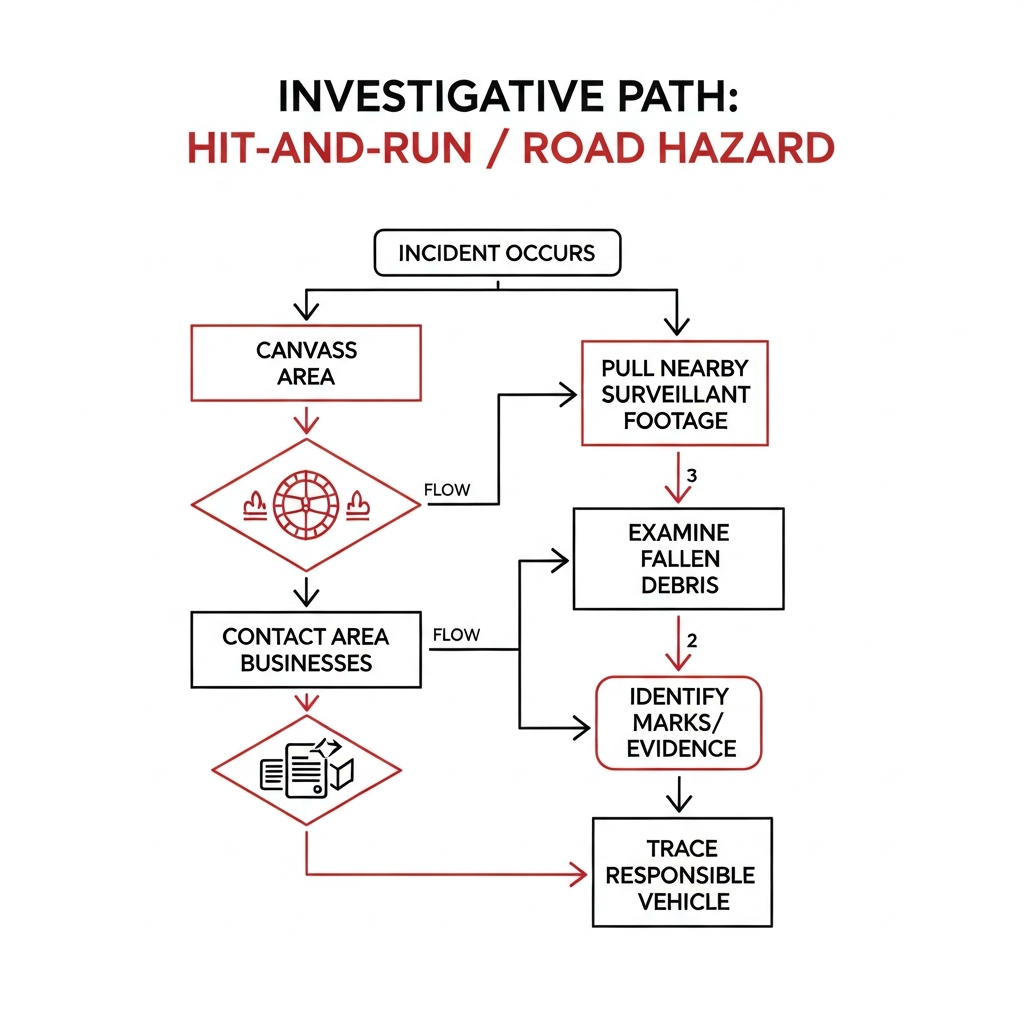
Hit-and-run cases are really hard, because the person who caused your injuries is gone. You cannot make a claim against someone you cannot name. And so the work starts with finding them. You need to go find surveillance. You need to identify who hit you so you can hold that person responsible.
Road-hazard cases are harder still, and the way we have proven them shows what that work actually looks like. One of ours involved cargo coming off a truck. A piece of metal fell off the back of a trailer, went through the windshield of a passing car, and killed the driver. The truck driver almost certainly never knew. Drivers in those situations keep moving, because they do not know something fell off their truck. Unless you can identify who that person was, it is hard to make a claim. So we did the work it takes to identify them. You canvass the area and find all the surveillance. You reach out to the various companies in and around the area to figure out where the truck was coming from and who it was associated with. And you look at what fell off, because if there are any identifying marks on it, that can help you identify which truck was involved.
Time Is the Enemy: Why Evidence Disappears
There is a clock running on every one of these cases, and it does not favor the injured person. The evidence that proves who was responsible is fragile. Video gets written over. Records get lost. And the more time that passes, the harder it becomes to identify who was responsible for the collision.
And so, if you have been in this kind of crash, it is so important to make sure that you get a lawyer who knows what they are doing involved quickly. A convenience store's surveillance system may overwrite its footage in days. The independent witness who saw the trailer may not be findable a month later. The work of canvassing and chasing down identifying marks only succeeds if it happens before the evidence is gone. The damages do not change, but the ability to prove your claim erodes by the day.
Pileups: How Joint and Several Liability Works in Texas
Pileups raise a question the simpler crashes do not: when several drivers are at fault, who pays for your injuries? Texas answers it with two related concepts.
The first is proportionate responsibility, the comparative-fault rule that runs through every Texas crash. The jury weighs the fault of every party involved, assigns percentages, and adjusts recovery accordingly. If your share of the fault is greater than 51 percent, you do not recover. If it is less, you recover, reduced by your percentage. The full rule lives in Texas Civil Practice and Remedies Code Chapter 33.
The second concept is joint and several liability, and it matters most in a pileup, where there are typically multiple individuals at fault. Picture the chain reaction. You stop. You do not hit anyone. Then you get plowed into from behind by other people. And in that situation you have the ability to file a lawsuit against every single person who caused that chain of events. The jury apportions fault among the various defendants. And here is the key factor: in the state of Texas, if a defendant is greater than 50 percent responsible, that defendant is responsible for all of the damages (excluding your share of responsibility), not just part of them.
That rule can decide whether an injured person actually gets paid. One car in the pileup may not have much insurance. But if a truck plows into the back of that pileup, an 18-wheeler can be responsible for all of the damages, even though other people are responsible as well. The commercial policy behind that truck makes the difference between a paper judgment and a real recovery. Because these cases so often turn on a commercial truck in the chain, they connect directly to our truck accident practice, where the same liability principles do the heaviest lifting.
Common Questions
- Can you still get compensation if the crash was a hit-and-run and you do not know who hit you?
- Yes, but the work comes first. You are still entitled to damages, but you first have to figure out who hit you so you can hold that person responsible. As Hank puts it, "you need to go find surveillance. You need to identify who is the person that hit you." That means moving fast, because the surveillance footage and records that identify the driver disappear over time.
- Who is responsible in a single-vehicle accident with no other driver?
- It depends on why the crash happened. If there was a faulty tire that was defective, you can make a claim against the tire company. If something faulty caused the brakes to go out, the claim may run against the part maker or against a body shop that failed to install them correctly. The damages are the same as any other collision. The harder part is figuring out who was responsible for it.
- In a pileup, can one driver be made to pay for all the damages?
- Yes. Under Texas joint and several liability, a defendant who is more than 50 percent responsible is "responsible for all of the damages, not just part of the damages." This matters most when one vehicle has little insurance and another, like an 18-wheeler that plows into the pileup, has coverage. That truck can be held responsible for all of the damages even though other drivers share fault.
- Why do these complicated cases have to move so quickly?
- Because the evidence that proves them is fragile. Video gets written over, records get lost, and the more time that passes, the harder it is to identify who was responsible. The investigation that wins these cases, canvassing the area and pulling surveillance, only works while that evidence still exists.
Chapter Reflection
The thread running through every one of these cases is the same. The law does not shrink your recovery because your crash was hard to prove. A pileup, a rollover, a hit-and-run, a piece of metal off a trailer, your damages are what your damages are. What these cases demand is the work of proving who is responsible before the evidence vanishes, and the knowledge of which Texas rules, proportionate responsibility and joint and several liability, decide who ultimately pays. That is also why the type of crash and the type of injury have to be read together. We have looked closely now at how the crash determines liability. The other half of the equation is the injury, and it is the injury that drives what the case is actually worth.