
Comparative Fault: How Texas Splits the Blame
Texas proportionate responsibility and the 51% bar
If there is one concept that decides what a Houston car accident claim is really worth, it is this one. Most people assume fault is a yes-or-no question: either the other driver caused the crash or you did. Texas does not work that way. Texas is a proportionate-responsibility state, which is another way of saying a comparative-fault state. That means a jury does not just point at one person and call it a day. It weighs the actions of everyone who was involved in the collision and assigns each of them a share of the blame.
Why does that matter so much? Because your share of the blame directly controls how much you can recover. It is not a side issue or a technicality. It is really the math at the center of your case, and it is the first thing a good lawyer thinks about when someone walks through the door describing a crash. It is the same thread Hank pulls on when he explains how car accident lawsuits are won in Houston, where fault, deadlines, and settlement leverage all come back to your share of the blame.
This chapter walks through how that weighing works, where the line sits that can wipe out your recovery entirely, and what happens when a crash involves more than two cars. Multi-car pileups bring in a second rule, joint and several responsibility, that can put a single party on the hook for all of the damages even when other people share the fault. None of this is intuitive, and that is exactly why it is worth slowing down on.
Proportionate responsibility is a very difficult concept, but it's a very important concept in the state of Texas. It's important because it'll affect the amount of damages you can recover. The jury in each case is asked to weigh the fault of every party that's involved in the case.
What proportionate responsibility actually means
When a Texas jury hears a car accident case, it does not simply decide who to side with. It is asked to weigh the actions of everyone involved in the collision and decide who it believes was responsible. And so that is what proportionate responsibility means in practice. The jury looks at your conduct and the conduct of the person who hit you, side by side, and decides how to apportion the blame between you.
Think about a T-bone crash at a Houston intersection. The key question is usually who had the right of way. If you did not have a stop sign or a yield sign and another driver pulled out and hit you, then you had the right of way and it should be their fault. But it is rarely that clean. There are occasions where somebody pulls out in front of you and you were speeding along too fast at the same time. In that situation, the driver going too fast could also be at fault. The jury is asked who did what, and whether their actions were reasonable, and then it sorts out the responsibility from there.
And so that is the part most people miss. Fault is not binary. Two drivers can both walk away from the same crash carrying a piece of the blame, and at the end of the day the jury's job is to decide how big each piece is.
The 51% line that can erase your recovery
Once the jury decides everyone was involved, it gives each person a percentage. Were you speeding? Did you cut someone off? Did you slam on your brakes? The jury answers those questions, decides who was at fault, and then assigns the numbers. Those numbers are not just bookkeeping. They control whether you recover anything at all.
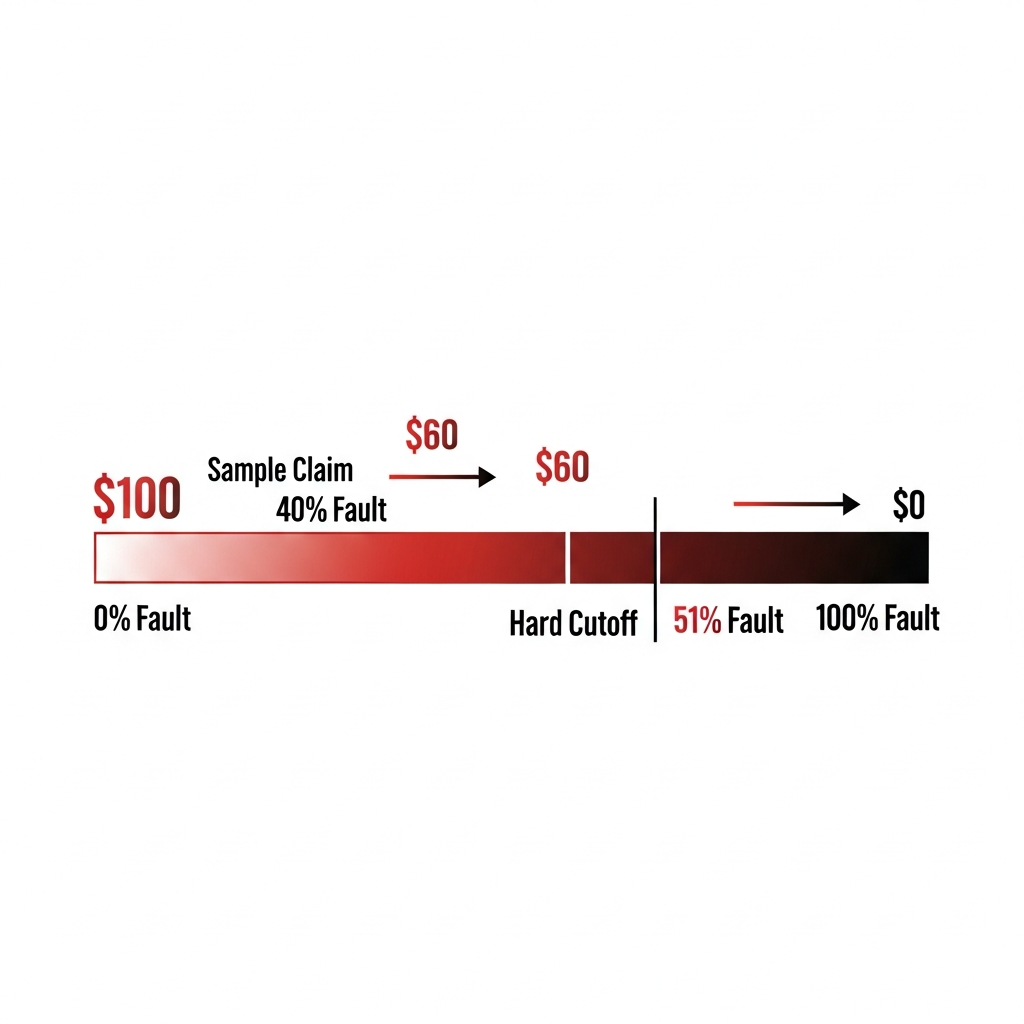
In the state of Texas, if your percentage of fault is greater than 51%, you do not recover for your injuries. Cross that line and the door closes, no matter how badly you were hurt. If your percentage is less than 51%, you can recover, but your recovery is reduced by your share of the fault. This is the rule Texas codifies in its proportionate-responsibility statute, Chapter 33 of the Civil Practice and Remedies Code, and it is critical to understand the Rule and its affect on your case.
Here is the way the process works in plain terms. Say your overall damages come to a hundred dollars, and the jury finds you 40% at fault. Your damages get reduced by $40, and you walk away with $60. That is the whole mechanic. The bigger your share of the blame, the smaller your check, until you hit the 51% wall and it goes to zero. And so the fight over fault percentages is not academic. A few points in either direction can really be the difference between a real recovery and nothing.
Why a defendant fights so hard over your percentage
Understanding the math explains a lot about how the other side behaves. If the insurance company or the at-fault driver can push your share of the blame up, they pay less, and if they can push it past 51%, they pay nothing. That is the whole game on the defense side.
It is also why documenting what happened matters so much in the moment. When someone gets rear-ended, the at-fault driver often claims they were cut off or that someone slammed on their brakes in front of them. The same instinct shows up in nearly every disputed crash. And so taking pictures, gathering witness information, and preserving the evidence is what proves the other person was in fact at fault, and it is what makes sure that your fault percentage stays where it belongs. Time works against you here, because the proof that pins the blame correctly is the proof that disappears first.
Joint and several responsibility in a multi-car crash
Two-car crashes are the simple version. The harder version is a pileup, and Texas has a second concept for those: joint and several responsibility. In a chain-reaction crash, there are typically multiple people at fault, and the law lets you go after all of them. If you stop and you do not hit anyone, but then you get plowed into from behind by other drivers, you have the ability to file a lawsuit against every single person who caused that chain of events that led to your injuries.
And so here is where it gets powerful. The jury apportions fault among the various defendants, just like in a two-car case. But if one of those parties is found to be greater than 50% responsible, that party is on the hook for all of the damages (except your individual share of fault), not just their slice of them. That is really the key factor. What that means is a single defendant can be made to pay the entire award even though other people also share the blame.
Why does that matter to a real client? Because of insurance. Picture a pileup where one car does not carry much coverage, and then an 18-wheeler plows into the back of the whole thing. If that 18-wheeler is more than 50% responsible, it can be responsible for all of the damages, even though other drivers were responsible too. The well-insured, heavily-at-fault party gets pulled in for the full amount. And so for someone seriously hurt in a multi-vehicle collision, that rule can really be the difference between a paper judgment and a recovery that actually gets paid. This is one reason serious Houston car accident and truck accident cases turn on figuring out exactly who was responsible and by how much.
Common Questions
- What does proportionate responsibility mean in Texas?
- It means a jury weighs the actions of everyone involved in a crash and assigns each person a percentage of fault, rather than deciding the case is one driver's fault or the other's. As Hank puts it, "the jury weighs everyone's actions, who is involved in an accident and decides who they believe was responsible for the collision." Your percentage then controls how much you can recover, which is why it is treated as the foundation of nearly every case.
- Can I still recover money if I was partly at fault for the crash?
- Yes, as long as your share of the fault is not greater than 51%. Below that line you can recover, but your award is reduced by your percentage of fault. "If you're 40% at fault, then your overall damages, let's say it was a hundred dollars, would be reduced by $40 and you would get $60." Once your fault crosses 51%, you recover nothing, so where the jury draws that line is everything.
- How does fault work when more than two cars are involved?
- In a pileup you can sue every person who caused the chain reaction that led to your injuries. The jury apportions fault among all of them. Under joint and several responsibility, any party found more than 50% responsible can be held liable for all of the damages, not just their portion. That rule often matters most when one heavily-at-fault party, like an 18-wheeler, carries enough coverage to actually pay the full award.
Chapter Reflection
Comparative fault is the lens every other part of your case gets viewed through. You can have serious injuries, strong medical evidence, and a sympathetic story, and still walk away with little or nothing if the jury assigns you too much of the blame. That is not a reason to be discouraged. It is a reason to take the fault question seriously from day one, to document what happened, and to get the right people sorting out who was responsible before the evidence fades. And so the deeper point is the one Hank keeps returning to: at the end of the day, the goal is to be treated fairly, and a jury can only do that if it understands the full picture of who did what. Fault determines if you have a right to recover for your injuries. Fault sets the ceiling on your recovery. The next piece of the equation is what fills it in, the nature and extent of your injuries, and that is where we turn next.