T-Bone Crashes and the Right-of-Way Question
Intersection collisions and who had the right of way
T-bone accidents are some of the most disputed crashes on the road, and in a city like Houston, they happen constantly at intersections. One car is moving through, another comes across its path, and the front of one vehicle slams into the side of the other. The damage can be severe, but the part that drags these cases out is rarely the physics. It is the fight over who was supposed to yield.
Almost every intersection collision comes down to a single question: who had the right of way. That is the question a jury gets asked to answer, and the way they answer it shapes everything that follows. Liability, the strength of your claim, and ultimately what your case is worth all flow from that one determination. And so before you can talk about what a T-bone collision is worth in the state of Texas, you have to understand the way the process works for sorting out fault at the intersection.
This chapter walks through how a jury actually thinks about an intersection crash, why the driver without a stop sign or yield sign generally has the right of way, and why "the other guy pulled out in front of me" does not always end the conversation. A driver who had the right of way can still share some of the blame if they were speeding into that intersection. That is the doorway into a rule that runs underneath every Texas car accident claim, and it is the subject of the next chapter.
When you have a T-bone accident, the key is who had the right of way. The jury's going to be asked who did what and were the actions reasonable. And so a determining factor is going to be who had the right of way, meaning if you didn't have a stop sign or a yield sign and then someone pulls out and hits you, well, then you had the right of way and it should be their fault.
Why intersection crashes get disputed
The reason T-bone collisions turn into fights is that there is usually no agreement on what happened. In a rear-end collision, the car behind almost always bears responsibility, so the argument tends to be about the injuries rather than the fault. An intersection is really different. Two drivers approach from different directions, each believes they had the green light or the clear path, and the impact happens in a fraction of a second. Memories conflict. Stories conflict.
That uncertainty is exactly why these cases land in front of a jury. When the insurance companies cannot agree on who caused the collision, the question gets handed to twelve people who weren't there and have to reconstruct it from the evidence. And so their job is to figure out what each driver did and whether what they did was reasonable. The evidence you bring to that question is what decides it, which is why documenting an intersection crash matters so much. The same care that proves fault in a Houston car accident claim applies here.
What the jury is actually asked
A jury evaluating a T-bone crash is not handed a verdict and told to rubber-stamp it. They are asked to weigh the conduct of each driver. Who did what. Were their actions reasonable. Those are the questions, and they are deliberately framed around behavior, not just outcome.
The right of way is the determining factor inside that analysis. It gives the jury a baseline for measuring whether each driver acted reasonably. A driver who had the right of way and proceeded through the intersection was, generally, behaving as the rules of the road expect. A driver who was supposed to stop or yield and didn't was not. So when the jury reconstructs the crash, the right of way tells them where the expectation of reasonable conduct sat in the first place.
Why the driver without a stop or yield sign generally has the right of way
The rule itself is straightforward, and Hank states it plainly: if you didn't have a stop sign or a yield sign and someone pulls out and hits you, then you had the right of way, and it should be their fault. The driver controlled by a sign is the one carrying the legal duty to wait. The driver on the open road is entitled to proceed.
And so that is why the person who pulls out is usually the one who answers for the collision. They had the obligation to yield, they failed to meet it, and the crash is the result. For most intersection collisions, that is where the analysis lands and the at-fault driver is clear. But "generally" is doing real work in that sentence, because there is a second set of circumstances where it does not end there.
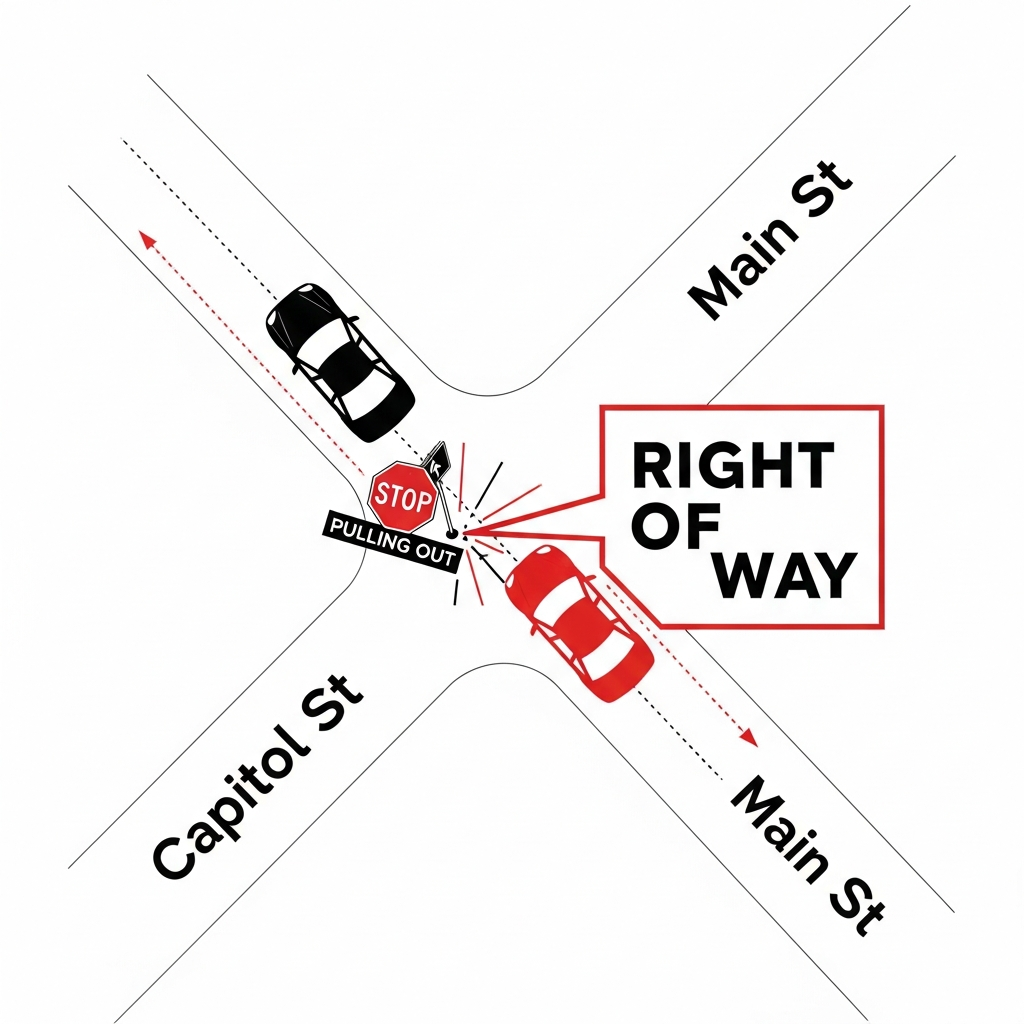
Here is the part that surprises people. Having the right of way does not make you automatically blameless. There are occasions where somebody pulls out in front of you, but you were speeding along too fast. In that situation, the driver going too fast could also be at fault, even though the other driver is the one who pulled out.
The reason is that the jury is weighing everyone's conduct, not just identifying the first person who broke a rule. Yes, the driver who pulled out had a duty to yield. But the driver who came barreling toward the intersection at an unreasonable speed also failed to behave reasonably, and that failure may have contributed to the crash or made it worse. So the jury can look at both drivers, decide that each did something wrong, and assign responsibility accordingly.
This is where the law in the state of Texas has a specific name for what the jury is doing. Texas is what's called a proportionate-responsibility state, and what that means is the jury weighs the actions of everyone involved in an accident and decides who they believe was responsible for the collision. It is not always one driver or the other. It can be a split, and the jury is the one who divides it.
A preview of proportionate responsibility
That concept is the lens for the whole right-of-way question, so it is worth naming clearly before we move on. In a proportionate-responsibility state, fault is not a yes-or-no switch. The jury can find that the driver who pulled out was mostly responsible and that the speeding driver carried a smaller share. Both can be at fault at the same time.
What that shared fault actually does to your recovery, how the percentages get assigned, and the threshold where it can wipe out a claim entirely is a detailed mechanic that deserves its own treatment. The point for now is just this: the right of way starts the conversation about an intersection crash, but proportionate responsibility is what finishes it. The next chapter takes that rule apart and shows exactly how the math works.
Common Questions
- Who is usually at fault in a T-bone accident in Houston?
- Usually the driver who failed to yield the right of way. As Hank puts it, "if you didn't have a stop sign or a yield sign and then someone pulls out and hits you, well, then you had the right of way and it should be their fault." The driver controlled by a sign carries the duty to wait. But fault is not automatic for either side, because a jury weighs what both drivers did and whether their actions were reasonable.
- Can I still be at fault if the other driver pulled out in front of me?
- Yes, in some circumstances. Hank explains that if somebody pulls out in front of you but you were "speeding along too fast," the driver going too fast "could also be at fault." Having the right of way does not make you automatically blameless. Texas juries weigh everyone's conduct, so an unreasonable speed can put a share of the responsibility on the through-driver even when the other driver yielded improperly.
- What does it mean that Texas is a proportionate-responsibility state?
- It means fault is not all-or-nothing. The jury weighs the actions of everyone involved in the accident and decides who they believe was responsible for the collision, assigning responsibility among the drivers rather than picking a single one. Under Texas proportionate-responsibility rules, more than one driver can share fault for the same crash. How those percentages affect what you recover is covered in the next chapter.
Chapter Reflection
Intersection crashes feel like they should be simple. One driver clearly had the path, the other clearly cut across it. But the dispute is rarely that clean, and the whole case turns on a single question the jury has to answer about who had the right of way. The driver without a stop or yield sign generally holds it, and the driver who pulls out generally answers for the collision. And so what makes Texas different is that the answer doesn't have to be one driver or the other. A jury can look at a speeding through-driver and an improperly yielding cross-driver and decide they both share the blame. That shared-fault idea is really the engine running underneath every Texas car accident claim, and once you see how the percentages actually get assigned, you understand why the right-of-way question is only the beginning. That is where we go next.