
Rear-End and Head-On Collisions: Fault and Force
How force and the rules of the road decide fault
These are the two crashes people ask me about most, and for almost opposite reasons. A rear-end looks simple from the outside, so people assume their case is automatic. A head-on looks devastating, so people assume the value takes care of itself. And both assumptions miss what actually happens once a claim is real. In a rear-end, the law leans your way, but leaning your way is not the same as proving your way, and the at-fault driver almost never just admits it. In a head-on, the force is really the story, and the force is what carries the value of the claim.
This chapter goes underneath the surface of both. For the rear-end, I want to walk through the defense playbook, who carries the burden of proving fault, and the specific documentation that turns a strong-looking case into a won one. For the head-on, I want to follow the chain that actually drives compensation: the speed creates the force, the force creates the injury, and the injury creates the value. And so here is the thing to hold onto: in the state of Texas, neither of these is decided by how the collision looked in the moment. It is decided by what you can prove later. Hank lays out how police reports and evidence win car accident lawsuits in Houston in his own episode on it, and this chapter puts that same proof to work on the rear-end and the head-on.
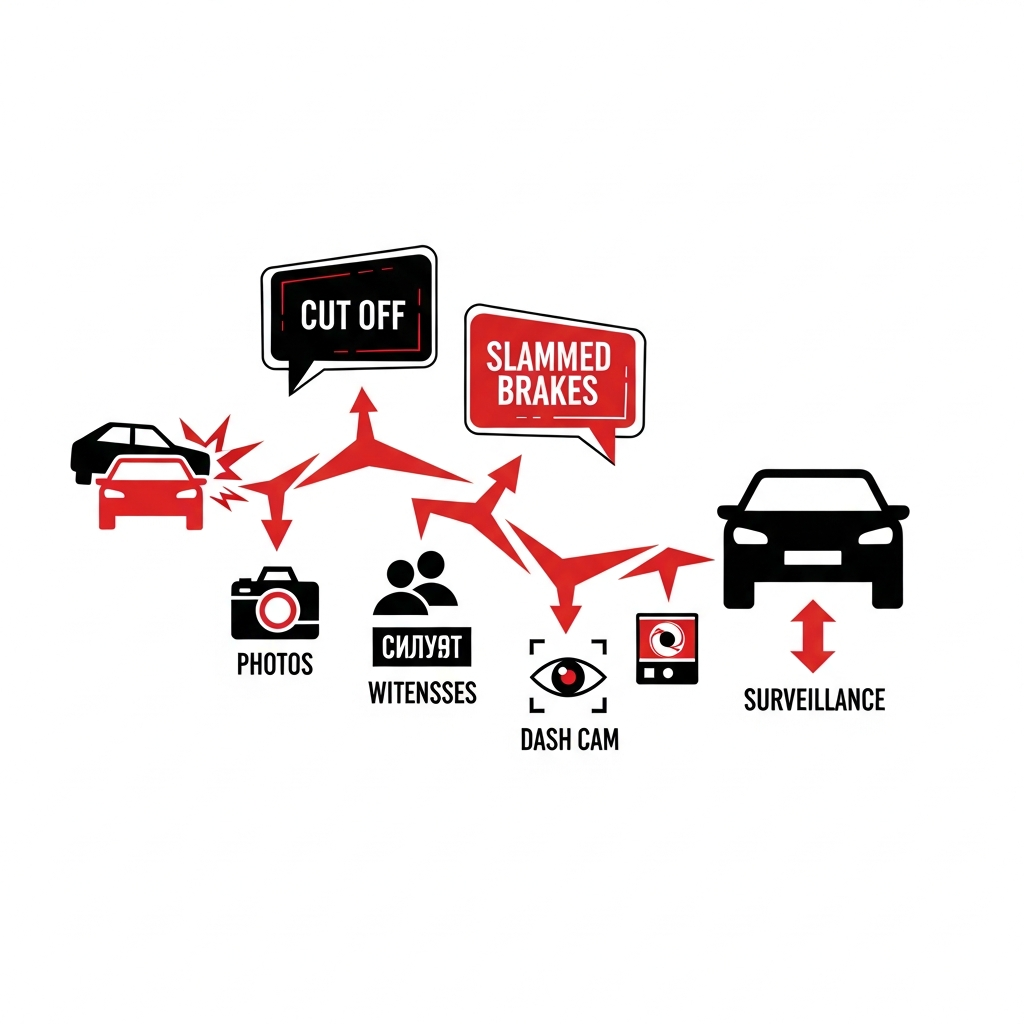
It's usually a stronger case. But oftentimes the at-fault person's going to say that they were cut off or someone slammed on their brakes in front of them. And so documenting what happened, taking pictures, making sure that you have all the information is really critical to helping prove that in fact, the other person was at fault for the collision.
Why a rear-end is usually a stronger case, and why "usually" matters
When someone gets rear-ended on a Houston highway, it is usually a stronger case. The default expectation is that the driver who came from behind had the duty to leave room and stop in time, and most of the time that is exactly how it plays out. But "usually" is doing real work in that sentence. A stronger starting position is not a finished case, and treating it like one is how people lose ground they should have kept.
The reason it is only "usually" is that fault in Texas is never assumed for you. It has to be established. A claim that looks airtight on the day of the crash can soften over the weeks that follow, because the other side gets to tell its version too. So the right way to think about a rear-end is this: the law gives you the better hand, and your job is to make sure the evidence still supports that hand by the time anyone is actually deciding the case.
The defense playbook: "I was cut off" and "they slammed on their brakes"
Here is what the at-fault driver almost always says. They say they were cut off. Or they say the person in front of them slammed on their brakes for no reason. Those two lines are the entire defense playbook in a rear-end, and they exist for one purpose, which is to move the fault off the person who hit you and onto you.
This is not a fair process. The way the process works, it is an adversarial one, and the other side gets to argue it however they want. A defendant does not need proof to float the suggestion that you stopped short or merged carelessly; they just need enough doubt to chip away at what looked like a clean case. And that is why the early appearance of strength can be deceptive. The story the defense tells does not have to be true to do damage. It only has to go unanswered. And the thing that answers it is not your word against theirs. It is the record.
Who has to prove fault, and what actually carries that burden
As the injured person bringing the claim, the burden of proving the other driver was at fault sits with you. The defense does not have to prove they were innocent. You have to prove they were responsible. That is the part people are surprised by, because it feels backward when you are the one who got hit. But it is why documentation is not a nice-to-have in a rear-end. It is the case.
So what carries that burden? Documenting what happened, taking pictures, and making sure that you have all the information. What that means is the photos of both vehicles and where they ended up, the position of the damage, the scene itself. And it means witness statements from anyone who saw it, because an independent person who watched it happen is worth more than either driver's account. In the age of cell phones, everyone always seems to have a camera on, and a dash cam video can be especially powerful, because it tells the story of what happened from an independent third party that people can see and understand. That kind of evidence is hard to find unless you really start looking for it, and the police are not going to go looking for it for you. In a normal collision, the officers are not going to canvass the area or pull surveillance from nearby businesses. They have too much going on. That investigation is the work that proves your stronger case is actually yours, and it is a big part of why a Houston car accident lawyer is worth bringing in early.
Head-on collisions: how speed becomes force, and force becomes injury
A head-on is a different animal, and the difference starts with physics. When you have a head-on collision, you are usually at high speed. Both cars are traveling at high speeds, and the forces associated with that are usually pretty great. That is not a detail. That is the whole reason these cases are what they are.
When you have those types of forces, the injuries are often much more significant. We handle a lot of head-on collisions that involve death or dismemberment, and they can permanently impact a family's life. Follow that chain, because it is the chain that matters: the speed creates the force, the force creates the injury, and the severity of that injury is what drives the value. People sometimes think the value of a head-on comes from how dramatic the crash looked. It does not. It comes from what the impact did to the person, and how the rest of their life is going to be different because of it. The crash is the cause. The injury is the measure.
Why severity itself drives the value of the claim
In a head-on, you are usually not fighting over who was at fault the way you are in a rear-end. The harder, more important work is showing the full weight of what the injury took. The more severe and permanent the harm, the larger the claim, because the harm reaches further into the person's life and further into their future. A catastrophic injury is not just expensive today. It changes earning ability, quality of life, and the things a person used to be able to do, sometimes for life.
That is the through-line that connects this chapter to the spine of the whole book. The type of crash sets up the kind of fight you are in. A rear-end is a fight about fault. A head-on is a fight about severity. But in both, what the case is worth comes down to the same thing: proving, with real evidence, what actually happened to a person and how it is going to follow them. You can read more about how the firm handles these on the car accidents practice page.
Common Questions
- If I got rear-ended, isn't the other driver automatically at fault?
- Usually it is a stronger case, but not an automatic one. In the state of Texas, fault is never assumed for you; it has to be proven, and the burden is on you. The at-fault driver will often claim you cut them off or slammed on their brakes in front of them. That is why pictures, witness statements, and any dash cam or surveillance footage matter so much. The law gives you the better starting position, and the evidence is what keeps it.
- What evidence helps prove fault in a rear-end collision?
- Start with documenting what happened, taking pictures, and making sure you have all the information from the scene. Photos of the vehicle positions and damage, statements from anyone who witnessed it, and dash cam video all help. In the age of cell phones, everyone always seems to have a camera on, and independent footage can tell the story for you. The police usually will not canvass the area for surveillance, which is where a lawyer's investigation becomes important.
- Why are head-on collision claims usually worth more?
- Because of the force involved. In a head-on, both cars are usually traveling at high speed, and the forces associated with that are usually pretty great. Greater force means more significant injuries, and these crashes can involve death, dismemberment, or harm that permanently impacts a family's life. The severity of the injury, and how it affects the rest of someone's life, is what drives the value of the claim.
- Should I take pictures even if the other driver admits it was their fault at the scene?
- Yes. What someone says at the scene is not what gets argued later. Once a claim is real, the other side gets to tell its own version, and an early admission can quietly turn into "I was cut off." Photographs, the position of the vehicles, and witness information lock down the facts while they still exist, before time and the adversarial process have a chance to blur them.
Chapter Reflection
The lesson underneath both of these crashes is the same, even though they look like opposites. A rear-end gives you the stronger hand and tempts you to relax; a head-on gives you the obvious severity and tempts you to assume the value is automatic. Neither is true. What carries a rear-end is the evidence that answers the "you cut me off" story before it sticks. What carries a head-on is proving the full reach of an injury that the force made permanent. So the work is the same work, pointed at different targets. Preserve what happened, and prove what it cost. That is what keeps a strong case strong and what gives a severe injury the value it deserves. The next chapter turns from the crash to the body, because once fault and force are settled, what your case is really worth is decided by the type of injury and how far it follows you.