
Lost Wages, Earning Capacity, and Claims Against the Government
Economic loss and the special rules for government claims
For a lot of people, the medical bills are the first thing they think about after a serious crash. They are real, they pile up fast, and they are easy to count. But for someone who is badly hurt, the bigger number is often the one that does not show up on a hospital invoice at all: the income they can no longer earn, and the earning capacity the injury took away from them for the rest of their working life. And what that means is that lost wages and reduced earning capacity can be a very large part of a person's damage model, and in the most serious cases they dwarf everything else.
This chapter covers that side of the equation, and then it covers a different problem that comes up when the person who hit you works for the government. When a TxDOT truck or a city vehicle is involved, the ordinary rules change. There is a doctrine called sovereign immunity that says you cannot sue the government unless the government has agreed to let you. Texas has agreed, but only on its own terms, with its own damage caps and its own strict notice deadlines. Miss one of those deadlines and the claim is gone, no matter how strong it was.
And so both of these issues share the same lesson. The harm from a crash reaches a lot further than the emergency room, and capturing the full picture, or preserving the right to be compensated for it at all, takes real work done early and done right.
I just finished a case where it was a head-on collision where a man was hit by an 18 wheeler, and he was in the military and he sustained significant brain injuries and some burn injuries and some other physical injuries. But his injuries were such that he was medically discharged from the military. And he was three years short of reaching his 20 years of service. And so my job as a lawyer is to figure out, well, how does that impact him economically?
When Lost Income Dwarfs the Medical Bills
Past medical bills are only one line in a Texas damage model. The full list includes future medical bills, past lost wages, and future loss of wage-earning capacity, alongside the non-economic damages for pain, suffering, mental anguish, and disfigurement. For a person who can still go back to work, the wage piece may be small. For a person whose injuries close the door on the career they had, it can be the largest number in the case.
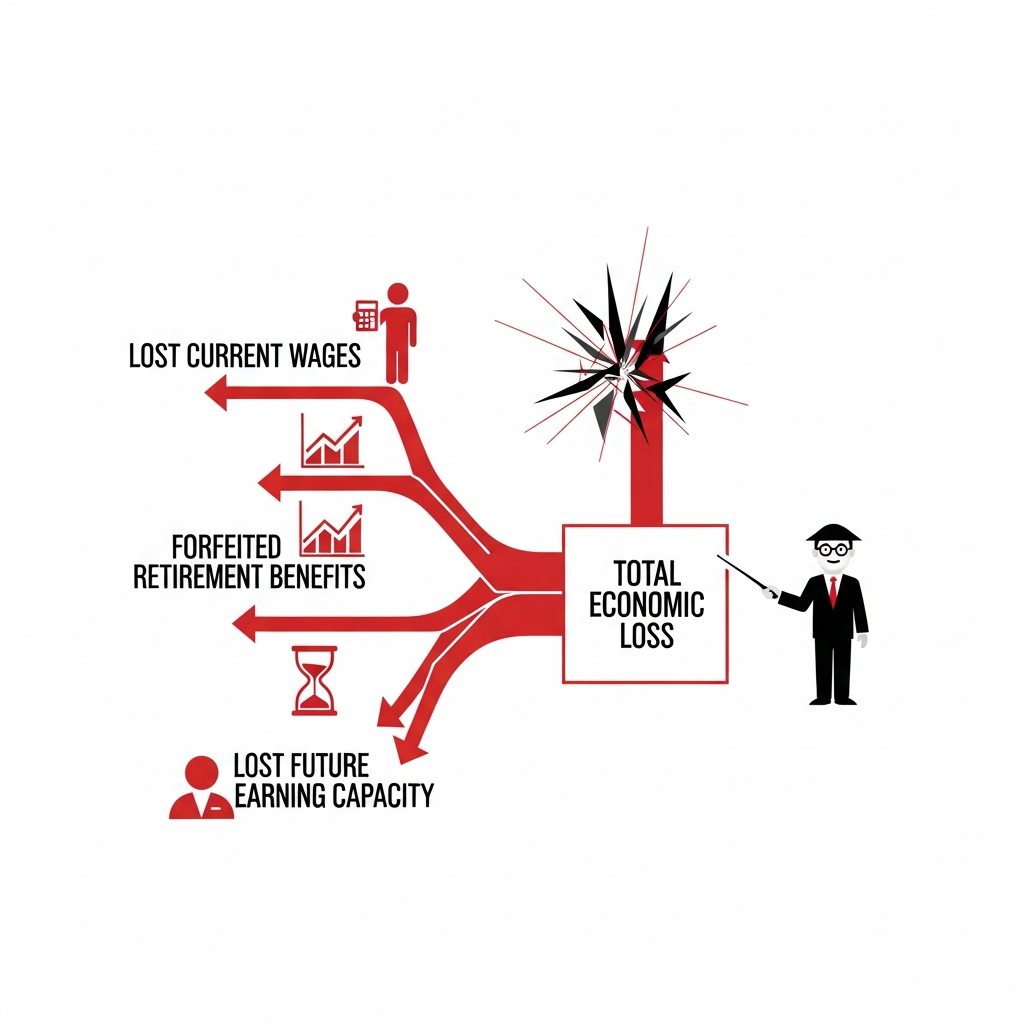
The case I just finished is a good illustration of how far that number can reach. A man in his early forties was hit head-on by an 18-wheeler. He came out of it with significant brain injuries, some burn injuries, and other physical injuries, and they were serious enough that he was medically discharged from the military. He was three years short of reaching his 20 years of service. That detail mattered enormously, because in his line of work 20 years was the line that unlocked full military retirement starting on the day he retired.
So my job as a lawyer was to figure out how all of that affected him economically. He had planned to finish his service, collect his retirement, and then take a second job on top of it. Now he could not do work at all because of his injuries, and he had lost his retirement benefits from the military. And so there were residual consequences stacked on top of one another: his ability to earn a living for his family, his ability to reach retirement with the military, and his ability to get medical insurance through the military all took a hit from a single collision that was not his fault.
Proving Earning Capacity Takes the Right Experts
You cannot stand in front of a jury and simply assert that a loss like that runs into the millions. You have to build it, piece by piece, and that means bringing in people who can speak to each layer of it with authority.
In this case we hired several experts. We hired a military expert to talk about the benefits and what they were worth. We hired a legal expert to talk about the various aspects of being discharged and how a medical discharge affects military benefits. And we hired an economist who walked through the value of all of those things and, since the man was no longer going to receive them, totaled up the amount of money he lost as a result. When you put all of that together, the total ran into the millions of dollars for this man, because of an injury that was not his fault but that permanently impacted his ability to earn a living for his family.
That is what it takes to do this right. The principle is the same one that runs through every serious case: our goal is to try to figure out how the injury actually affects a person's life, and then put a defensible monetary value on those harms and losses so a jury can fairly compensate them. The numbers do not speak for themselves. The experts make them speak. If you are facing this kind of loss after a serious collision, this is exactly the work a Houston car accident lawyer should be doing on your behalf from the start.
Sovereign Immunity: You Cannot Sue the Government Unless It Lets You
Now shift to a different problem. Sometimes the vehicle that hits you is not a private car. It is a TxDOT truck, or a city employee driving a city vehicle, or a county vehicle. When that happens, you run into a concept called sovereign immunity.
What that means is that you cannot sue the government unless the government says you can sue the government. In an ordinary car accident case between two private drivers, that is not an issue. But when a governmental entity is the one that hit you, the default rule is that the government is shielded. In the state of Texas, the state has chosen to lift that shield in certain situations through the Texas Tort Claims Act. So if a TxDOT truck hits you, or a city employee in a city vehicle hits you, Texas has said, in effect, you have permission to sue the state of Texas. That permission is the whole reason the claim can exist at all, and it is the starting point for everything that follows.
Damage Caps and Strict Notice Deadlines
The permission comes with limits, and they are real ones. You have permission to sue the government only up to a certain level of damages, and that level depends on who hit you. Was it police? There is a different cap for that. Was it a county? A different cap. Was it a city vehicle, and if so, how big is the city you were in? Different cap again. So even when the immunity is lifted, the recovery is boxed in by a ceiling that varies with the type of entity involved.
The other thing that is really important, and the one that catches people, is timing. When you sue under the Texas Tort Claims Act, there are very specific notice provisions you must comply with. You have to make sure that you give notice to certain individuals within a timeframe specified under the act. If you are going to make a claim against TxDOT, for example, you have to give notice to the director, and it has to be within a certain prescribed time period. If you do not give that notice within the prescribed period, you lose the ability to make a claim against Texas. Not your damages reduced, not your case weakened. Gone. You failed to give proper notice, and that is the end of it.
And so a collision with a governmental entity, or even a crash in a construction zone where a claim against TxDOT might be on the table, is one of the situations where getting a lawyer involved quickly is not optional. The notice clock is shorter and less forgiving than the deadlines people are used to, and there is no second chance once it runs.
Common Questions
- Can lost wages really be worth more than my medical bills in a Texas injury case?
- Yes. Lost wages and the impact an injury has on a person's ability to earn a living can be a very large aspect of a person's damage model, and in serious cases they can exceed the medical bills. As Hank explains when he walks through earning capacity on the podcast, "the impact that an injury has on a person's ability to earn a living can be a very large aspect of a person's damage model." Texas lets you recover past lost wages and future loss of earning capacity, so the number reflects your whole working life, not just time already missed.
- How do you prove how much future income a serious injury cost me?
- You build it with the right experts. In a recent head-on case where a military servicemember was medically discharged short of his 20-year retirement, the firm hired a military-benefits expert, a legal expert on how discharge affects benefits, and an economist to total the loss, which ran into the millions. The experts translate forfeited wages, benefits, and earning capacity into a defensible number a jury can understand and fairly compensate.
- What is sovereign immunity, and can I still sue if a government vehicle hit me?
- Sovereign immunity means you cannot sue the government unless the government says you can. Texas has agreed to let you sue through the Texas Tort Claims Act when, for example, a TxDOT truck or a city vehicle hits you. So you can bring a claim, but only on the state's terms, which include damage caps and strict notice requirements.
- Why are the deadlines different when the government is involved?
- Because the Texas Tort Claims Act imposes very specific notice provisions. You must give notice to certain individuals, such as the director in a TxDOT claim, within a prescribed time period. As Hank warns, if you do not give notice in time, "then you lose the ability to make a claim." These windows are short and unforgiving, which is why you want a lawyer involved quickly after any crash with a governmental entity.
Chapter Reflection
The thread running through both halves of this chapter is that a crash takes far more than what shows up on a hospital bill. For the seriously injured, the largest loss is often the future itself: the career, the retirement, the benefits, the capacity to provide. Putting an honest number on that takes the right experts and the patience to build the case piece by piece. And when the government is the party that caused the harm, even the right to be compensated has to be protected by acting before a short notice deadline quietly closes. And at the end of the day, both come down to the same thing: the value of a case is real, but it is not automatic. It has to be proven, preserved, and presented. That brings us to the side of the table that is doing everything it can to keep that number low, the insurance company, and how it decides what your case is worth.