
Insurance Settlements, Juries, and What to Do If Your Claim Is Denied
Settlements, juries, and the path after a denial
Everything in this book has been building on one question: how does the case actually resolve? You now understand some of the core considerations. The type of crash matters. The type of injury matters. And how you prove what that injury took from your life matters most of all. But none of that lands until you sit across the table from an insurance company, or stand in front of a jury, and someone has to put a number on it.
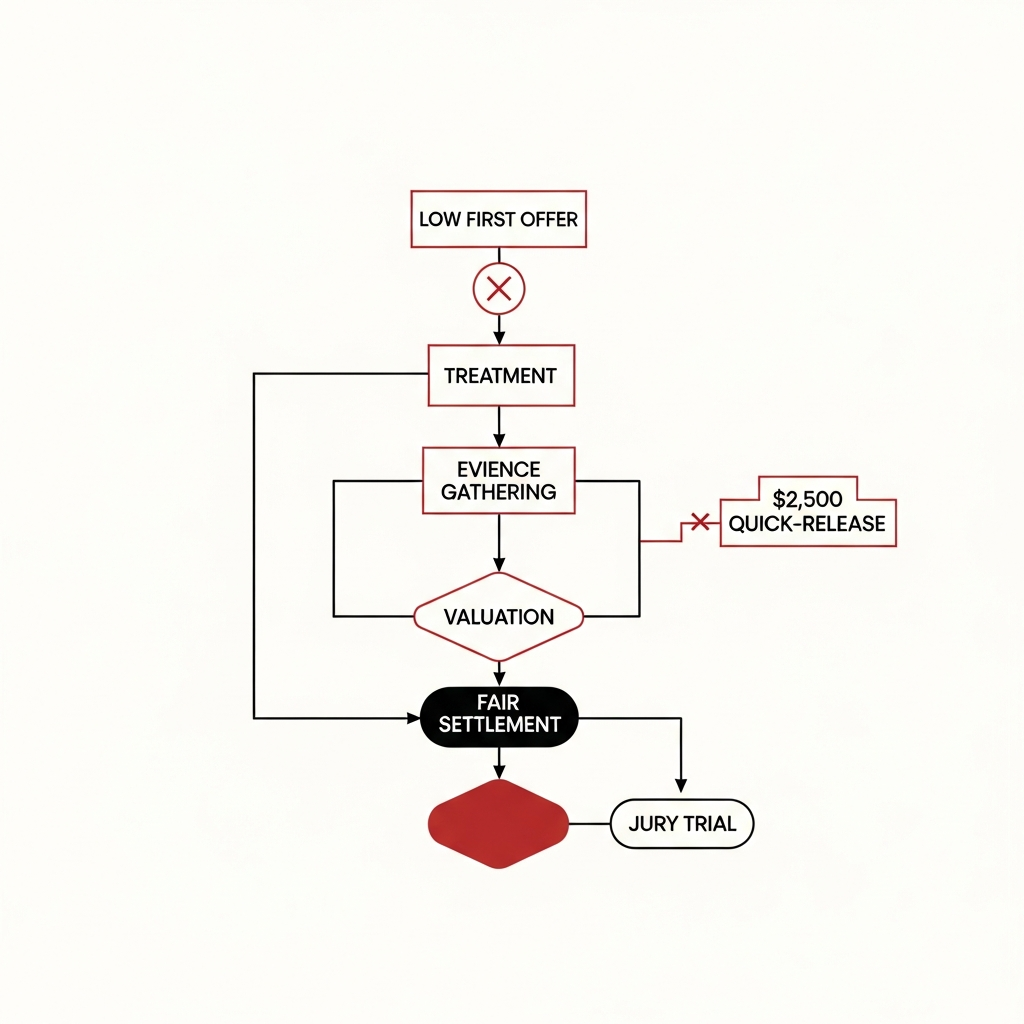
This is where most people get hurt a second time. The first settlement offer is usually shockingly low, and it tends to arrive while you are still treating, before anyone knows how serious your injuries really are. An adjuster calls, offers you $2,500 and a release to sign, and the whole thing feels like a relief until the problems do not go away. By then you have already signed away your case. Understanding how to file a car accident claim in Houston, Texas the right way, before that first call, is what keeps a quick $2,500 release from becoming the whole story.
This chapter covers how the resolution works from the inside. How insurance companies calculate what they offer. When you actually need a lawyer and when you do not. What evidence wins a case and why the police will not gather it for you. Why a jury of your community is fair when you show them how an injury changed a life. And what your options are if the insurance company simply denies the claim and dares you to do something about it.
I could care less what the insurance company thinks. I care what I think a jury's going to do, because at the end of the day, that's who gets to decide your case.
How insurance companies set the number
Every insurance company calculates settlement offers differently. Some are more reasonable than others, and some are completely unreasonable. But underneath the differences, they are all doing the same thing: trying to figure out what a jury would do with your type of case. That is the number behind the number. An insurance company has to set a reserve, an internal figure that says, this is what we think the claim will be worth. Setting that reserve is a real part of the adjuster's job, because it tells the company how to allocate resources for settling these claims.
Here is what follows from that. The insurance company can only set the reserve based on the information it has been given. If all it knows is that there was a collision and you went to the emergency room once, it will value the case as if that is the whole story. There is nothing wrong with sending medical records, billing records, and photographs to the insurance company, because that is relevant evidence they would get anyway if the case went to trial. What you should not do is speak to the insurance company directly or give a recorded statement. That is not in your best interest. The documents tell your story without handing the adjuster something to use against you.
The problem with settling early is that nobody knows the full picture yet, including you. The insurance company does not know all the problems with you. And you do not know all the problems with you, because you are still treating. That is why litigation is often helpful. Once a lawsuit is filed, both sides get a lawyer, both sides start talking about the damages and the extent of the injuries, and the case can be valued against prior jury results, the evidence, the lost wages, and every other element of damages. Only then can you have a realistic settlement discussion. Try to have that conversation too early and it is hard to make it realistic, because the case has not yet shown what it is.
The $2,500-and-sign-a-release trap
The low first offer is not an accident. It is a strategy that works on people who do not know better. An adjuster calls up and says, I'll give you $2,500 if you sign a release. People take it, because $2,500 feels like something when you are stressed and hurting and the bills are starting to come in.
Then the problems show up. Hank hears it constantly: someone calls and says the insurance company gave them $2,500 and a release, they signed it, and now they are having all these other problems. And the hard truth is that there is usually not a whole lot a lawyer can do at that point. You made a decision, you signed the release, and the case is closed. The release does exactly what it was written to do.
The lesson is simple and it is worth more than any negotiation tactic. Do not try to settle quickly. Take the time to figure out what is actually wrong with you, and whether those problems were caused by the collision. Once you understand that, you can start to figure out what the case is really worth. If you have injuries and pain that last more than a few weeks, talk to an injury lawyer about your case and your options before you sign anything. A release you sign today cannot be undone tomorrow when the symptoms get worse.
When you actually need a lawyer
Not every case needs a lawyer, and a firm worth trusting will tell you so. Just because you have been in a collision does not mean you need to hire one. At Sutliff & Stout, the consultation is free, and a large share of the people who call get told they do not need a lawyer at all. They are told to wait a few weeks, see if the pain goes away, and if it does, here are some things you can do with the insurance company to settle for a reasonable amount on your own.
That honesty is the point, not a sales softener. The firm only wants to get involved in cases where it is adding value. If it cannot add value to a case, it does not want to take it. But the advice to call still stands, even for the cases the firm turns away, because a short conversation helps you start thinking clearly and make a good, informed decision. At the end of the day it is your claim. You are the one who has to live with the consequences. The whole goal is to make sure you do not leave money on the table and that you did right by yourself.
This is the difference between a firm that sees you as a file and one that sees you as a person making a decision. You can ask for that kind of honest read in a free consultation, and you should expect to hear the truth even when the truth is that you can handle this one on your own.
The evidence that actually wins, and why you have to find it yourself
People assume the police report and a few photos are the case. They are not. What evidence matters depends on the nature of the collision. If it was a hit-and-run, you need surveillance to figure out who the other driver was. If there is a dispute about who ran the red light, you need surveillance and witness statements. You need whatever pictures exist, and in the age of cell phones someone almost always has a camera on. Dash-cam video can be especially powerful, because it tells the story of what happened from an independent third party that a jury can see and understand for themselves.
The catch is that this evidence is hard to find unless someone really starts looking for it, and the police are not going to be that someone. In a normal run-of-the-mill collision, officers are not going to canvass the area or knock on convenience-store doors asking for surveillance footage. They have too much going on to run that kind of investigation. That is not a knock on them. It is just the reality of what their job is and is not.
This is one of the clearest places a lawyer adds value: conducting the investigation the police will not. Surveillance disappears. Stores overwrite their footage. Witnesses move on and forget. The evidence that proves your case is most available right after the crash and least available a few months later, which is one more reason time is not on your side. If you are dealing with a Houston car accident, the canvass for evidence is something that has to start while the trail is still warm.
Why Harris County juries are fair, and how you earn a fair verdict
Harris County has a reputation in the legal world when it comes to jury verdicts, but the reality behind the reputation is straightforward. Harris County jurors are fair. So are the jurors in every county. What drives the outcome is not the county. It is the extent of your injuries and how they have affected your life. So called conservative counties will still award large damages, but you have to show them all of the harms and losses.
When you talk to people, they understand that injuries can have a real and adverse impact on a person's life, and they will fairly compensate you for it. But you have to explain to them how it affected your life: what it did, what it took away, and the value of those things. That is the hard part, and that is where a lawyer helps. You want people to describe the problem. Not just the injured person, but their loved ones, coming in to say, this is what I have seen, this is what I have experienced. They paint the picture of a life that used to include fishing and tennis every day and now is mostly a person who cannot leave the house, sitting on the couch, visibly struggling. Those witnesses to the struggle are what let a jury understand.
The more witnesses you can give a jury to explain how the injury has impacted the person's life, the more likely the jury sees the case favorably and treats you fairly. This is the spine of the whole book reappearing at the moment of resolution. The crash type and the injury type set the range, but it is the proof of how the injury changed a life that moves the number inside that range.
The harsh reality of ability to pay
Everything in this chapter so far describes what a case is worth. There is a second number sitting underneath it, which is what can actually be collected, and the two are not always close. A verdict is a piece of paper that says what the harm was worth. A judgment collected is money in an injured person's hands. What stands between them is the ability of the person or the company who hurt you to pay.
Texas minimum liability limits are $30,000 for injury to one person, $60,000 for two or more people in one crash, and $25,000 for property damage, and the legislature has not raised them since 2011. One night in a Houston trauma center and a single surgery can exhaust $30,000 before anyone talks about pain and suffering. And plenty of drivers do not carry even that. The Texas Department of Insurance reported in 2025 that more than 2.4 million registered vehicles in the state are not matched to any insurance policy, which is roughly 12 percent of the vehicles on the road.
That is why the coverage on your own policy can matter as much as the coverage on theirs. Uninsured and underinsured motorist coverage sits on your policy and covers the gap the at-fault driver cannot, and a Texas insurer has to provide it unless you signed a written rejection. Most people have it and do not know they do.
Suing an uninsured individual rarely solves the problem, because Texas protects nearly everything an ordinary person owns from a judgment. The homestead is exempt with no limit on its value. Personal property is exempt up to $50,000 for individuals and $100,000 for a family. Current wages cannot be garnished for an ordinary judgment at all under the Texas Constitution. A defendant can lose a jury trial, keep a paid-off house, go back to work the next morning, and never write a check. That is what it means to say a judgment against someone who cannot pay is just a piece of paper.
So the real work happens early, and it is the work of finding who else is responsible and who else is insured. Was there an employer behind the driver? Was there a commercial policy behind the truck? Was there a second or third party in the chain who contributed to the crash? That search is what turned a $1 million policy into a multimillion-dollar trust for the little girl whose mother was killed in a recent pileup case we handled, and it is a large part of why we file suit early instead of trading letters. A case is only worth what somebody can actually pay, and finding that somebody is a separate job from proving the case.
Preparation is the leverage, and a denial is not the end
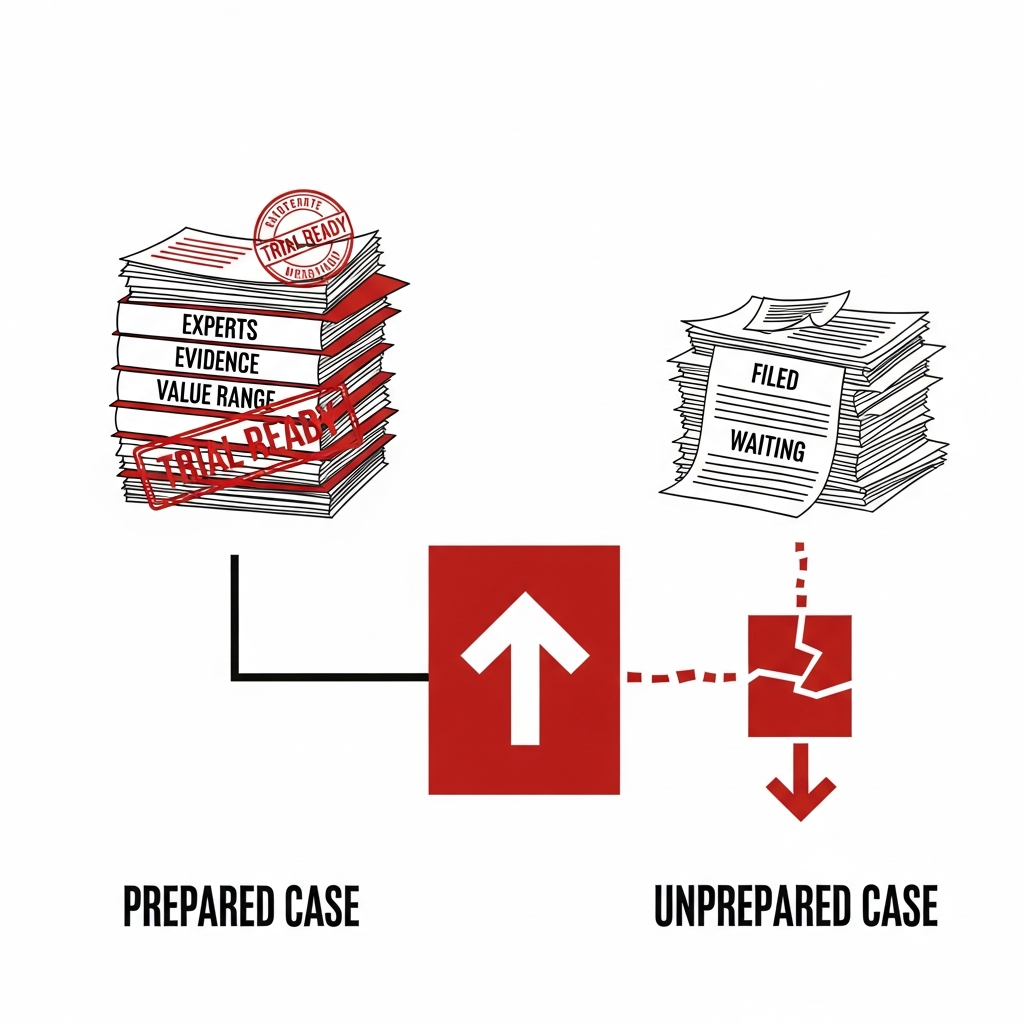
People want to know the secret to negotiating a better settlement, as if there is some magic sauce. There is not. What there is, is preparation. Prepare your case as though you are ready to go to trial, and the insurance company understands that and takes you seriously. Filing a case and then expecting the insurance company to pay you without doing any work is not a recipe for success. File a case and then expect the insurance company to pay you without doing any work, and it gets very hard to put your client in a strong strategic position.
Do the work and the picture flips. When you know what your case is about, you have the experts, and you have all the evidence you need, you can articulate in a clear format that the case is worth a specific amount. Each case has a range of value, and finding that range and improving it is the lawyer's job. To be successful in a negotiation you have to do the work necessary to define the range, then explain, to the insurance company and to the jury, why the case is worth what you say it is worth.
And if the insurance company simply denies the claim? It happens all the time, even in cases that look open and shut. People call after being rear-ended while stopped at a stop sign, and the insurance company is denying the claim anyway. Here is the part to hold onto: insurance companies do not have to be reasonable. They get to do whatever they want and then find a reason to call it reasonable. But you do not have to accept what they say. You have the ability to hire a lawyer, file a lawsuit, and bring a claim. If an insurance company will not treat you fairly in negotiation, you have the right in the United States of America to have a jury decide your claim, which means members of your community come together and decide what they think is fair in your particular situation. At that point what the insurance company thinks is irrelevant. The jury is the ultimate decision maker, and that is the only opinion that decides your case.
Common Questions
- How do insurance companies calculate a car accident settlement offer in Texas?
- They estimate what a jury would do with your type of case and set an internal reserve, the figure they believe the claim is worth. They can only base it on the information they have, so a case valued before you finish treating gets undervalued. As Hank puts it, they're looking at what they think a jury would do. Sending records and photos helps them value it accurately. Speaking to them directly does not.
- Should I accept the first settlement offer after my car accident?
- Usually not. The first offer is often shockingly low, sometimes a quick $2,500 in exchange for signing a release, and it tends to arrive while you are still treating and nobody knows how serious your injuries are. Once you sign a release, there's not a whole lot I can do for you, Hank notes. Take the time to learn what is wrong with you and whether the collision caused it before settling anything.
- Do I really need a lawyer for my car accident claim?
- Not always, and a good firm will tell you so. Just being in a collision does not mean you need a lawyer. Sutliff & Stout gives free consultations and tells many callers they do not need one, advising them to wait a few weeks and see if the pain resolves. The firm only takes cases where it adds value. If your injuries and pain last more than a few weeks, that is the point to call.
- What evidence is most important in a Texas car accident injury claim?
- It depends on the collision, but the evidence people miss matters most: surveillance footage, witness statements, and dash-cam video. Dash-cam video is powerful because it tells the story from an independent third party a jury can see for itself. The catch is that police will not canvass for it. They're not going to go canvass the area, Hank says, which is exactly where a lawyer's investigation adds value, before the footage disappears.
- What can I do if the insurance company denies my claim?
- A denial is not the end. Insurance companies do not have to be reasonable, and they will deny even clear cases, like someone rear-ended at a stop sign. You do not have to accept it. You can hire a lawyer, file a lawsuit, and bring your claim. You have the right in the United States of America to go and have a jury decide your claim, which means your community decides what is fair, and at that point the insurance company's opinion no longer controls the outcome.
- Can you still get compensation if the driver who hit you had no insurance?
- Often yes, but the money usually comes from your own policy rather than theirs. Uninsured and underinsured motorist coverage is built for that situation, and Texas insurers must provide it unless you rejected it in writing. Suing an uninsured driver personally rarely produces money, because Texas exempts the homestead with no dollar cap, exempts personal property up to $100,000 for a family, and does not allow garnishment of current wages for an ordinary judgment.
- What happens if my case is worth more than the at-fault driver's policy limits?
- The claim goes looking for another layer. That can be your own uninsured and underinsured motorist coverage, an employer or commercial policy behind the at-fault driver, an umbrella policy, or another party whose conduct contributed to the crash. It is also why joint and several liability matters in a pileup, because a defendant found more than 50 percent responsible can be held liable for all of the damages, and a well-insured party pulled into the case can change the recovery entirely.
Chapter Reflection
If there is one equation to carry out of this book, it is this: the type of crash, plus the type of injury, plus how clearly you prove what that injury took from your life, is what your case is really worth. Everything else, the reserve the adjuster sets, the offer that arrives too early, the denial that feels like a wall, is just the insurance company's guess about how that equation will land in front of a jury. There is no magic sauce. The leverage is preparation, the evidence is out there if someone goes and finds it, and a jury of your community is fair when you show them how a life was changed. So if you have been in an accident, the best thing to do is reach out to a lawyer, whether it is us or someone else, and get some free advice. Do not try to do it alone. Most lawyers in Houston will give you a straightforward, honest answer about your claim, and Sutliff & Stout certainly will. You can reach the firm at its website, sutliffstout.com, or by phone at (713) 987-7111, and that first consultation is free. If we think you need help, we will tell you. And if we think you can do it yourself, we will tell you that too.